Water is easy to take for granted when everything is running smoothly. In a commercial setting, though, water does much more than fill sinks and provide something to drink. It passes through coffee machines, ice makers, boilers, dishwashers, production equipment, cooling systems, and plenty of other expensive machinery.
When water quality isn’t suited to those applications, small problems can slowly turn into expensive ones. Scale builds up. Filters clog. Equipment works harder. Maintenance becomes more frequent. Eventually, something stops working at the worst possible time.
That’s why water treatment deserves to be viewed as part of business maintenance rather than just another utility expense.
Water Quality Can Affect Equipment Performance
Different water sources contain different levels of minerals, sediment, disinfectants, and other dissolved substances. Hard water, for example, contains calcium and magnesium that can contribute to scale formation.
You might first notice a little residue around a faucet or showerhead. In commercial equipment, however, the buildup can happen inside components where you can’t easily see it.
Over time, scale may reduce heat-transfer efficiency, restrict water flow, or interfere with moving parts. The exact effect depends on the equipment and water conditions, but the basic lesson is straightforward: water chemistry matters.
Expensive Equipment Deserves Protection
Commercial businesses often make significant investments in water-using equipment. A restaurant might have high-end espresso machines, steamers, ice makers, and dishwashers. A hotel could have hundreds of fixtures and water-heating systems. Manufacturing facilities may rely on water throughout their production process.
When water quality is appropriate for the equipment, businesses can better protect equipment investments and reduce some avoidable water-related stresses.
Of course, treatment isn’t a guarantee that equipment will never fail. Machines still need cleaning, inspections, repairs, and replacement parts. But managing water quality can be a useful part of a broader preventive-maintenance strategy.
Hard Water Is a Common Commercial Concern
Hard water is one of the most familiar water-quality challenges because its effects can become visible relatively quickly.
Mineral deposits may collect inside pipes, heating elements, valves, and other components. Equipment that heats water can be especially vulnerable because heating can encourage mineral precipitation and scale formation.
Commercial operations may use water constantly throughout the day, which means even a moderate hardness issue can become more significant over time.
That’s where properly sized softening equipment may be useful. The right solution depends on the water analysis and the specific equipment being protected.
Why Scale Can Become Expensive
Scale isn’t just an appearance problem.
Inside a water heater or boiler, mineral deposits can act as an insulating layer between the heating surface and the water. That can affect efficiency and operating performance.
In coffee and beverage equipment, mineral buildup can interfere with water pathways and internal components. In ice machines, deposits may contribute to cleaning and maintenance challenges.
The costs can add up quietly. More service calls. More cleaning. More replacement parts. More staff time spent dealing with equipment instead of customers.
It’s often the little expenses that eventually become a big one.
Preventive Treatment Can Help Avoid Disruptions
Business owners know that downtime can be painful.
If a restaurant’s main coffee machine stops working during the morning rush, that’s not merely an equipment problem. It can affect sales, staff workflow, customer satisfaction, and the entire day’s schedule.
A hotel with a water-heating issue has an even larger headache.
Appropriate treatment and regular maintenance can help businesses avoid costly downtime associated with certain water-quality and scale-related issues. It won’t eliminate every possible failure, but prevention is usually easier than emergency repair.
And let’s be honest, nobody enjoys discovering a preventable problem at 7 a.m. on a Monday.
Modern Filtration Is More Than a Basic Filter
Today’s commercial treatment options can be much more sophisticated than the simple filters people may remember from years ago.
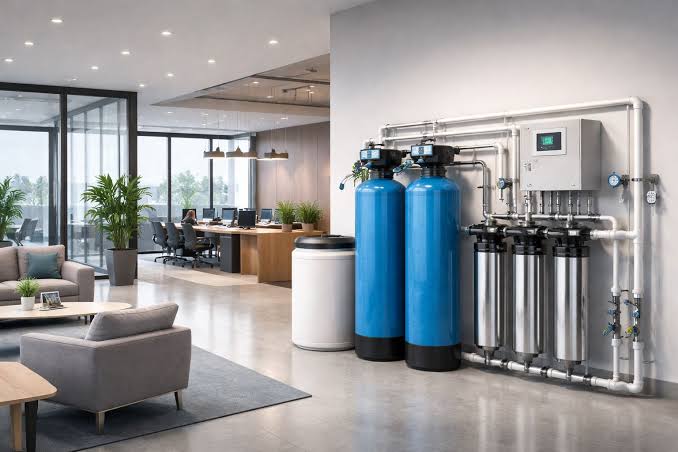
Depending on the application, businesses can use sediment filtration, activated carbon, water softening, reverse osmosis, deionization, ultraviolet treatment, and other technologies.
Modern commercial water filtration systems can be designed around specific water conditions and operational requirements rather than relying on a one-size-fits-all approach.
That flexibility is useful because every commercial property has its own combination of water chemistry, flow requirements, equipment, and usage patterns.
Start With Water Testing
Before purchasing equipment, test the water.
It sounds obvious, but it’s one of the steps people sometimes skip.
A water analysis can identify hardness, pH, dissolved solids, chlorine, sediment, iron, sulfur, and other characteristics that may influence treatment decisions.
For private wells, testing can be especially valuable because groundwater conditions can vary and may change over time.
Testing helps answer a basic question: what are you actually trying to fix?
Without that information, a business could spend money on equipment that addresses the wrong problem.
Different Equipment Needs Different Water
One of the biggest mistakes is assuming that all commercial equipment needs the same type of water.
A coffee machine may have specific recommendations for hardness and mineral content. A boiler can have different requirements. A manufacturing process may need water with very low dissolved solids.
Even equipment from the same manufacturer can have different specifications depending on the model.
That means water treatment should be coordinated with equipment requirements whenever possible.
Checking the manufacturer’s water-quality recommendations before installing treatment can prevent unnecessary complications later.
Pretreatment Can Make a Difference
Sometimes the best way to protect a treatment system is to treat the water before it reaches the primary equipment.
For example, sediment filtration can remove larger particles before they reach downstream components. Carbon treatment can address certain chlorine and taste concerns. Softening can reduce hardness before water enters equipment that’s sensitive to scale.
Reverse osmosis may also be appropriate when lower levels of dissolved substances are required.
The exact sequence depends on the source water and the intended application.
Think of it like preparing ingredients before cooking. A little preparation beforehand can make everything that follows work more smoothly.
Don’t Ignore Flow Rate
Commercial systems need to keep up with demand.
A business may have periods when several water-using machines operate at the same time. If the treatment system isn’t properly sized, water availability or pressure can become an issue.
Sizing should consider average usage, peak demand, operating hours, storage capacity, and future expansion.
A system that’s too small can become a bottleneck. One that’s far larger than necessary can increase purchase and operating costs.
The sweet spot is a system designed around real-world usage.
Maintenance Is Still Essential
Even the best treatment system needs attention.
Filters eventually become saturated. Softening systems require appropriate regeneration or servicing. RO membranes need monitoring. Pumps, valves, tanks, and other components may require periodic inspection.
Businesses should establish a maintenance schedule before problems appear.
Keep records of filter changes, service visits, water testing, and equipment performance where appropriate. It makes it easier to spot gradual changes that might otherwise go unnoticed.
Preventive maintenance isn’t glamorous, but neither is an emergency repair bill.
Look at the Long-Term Cost
When comparing water-treatment options, don’t focus only on the initial installation price.
Consider replacement filters, salt or treatment media, electricity where applicable, service costs, water consumption, and expected equipment life.
Also consider the cost of interruptions.
If a treatment system costs a little more but helps support reliable operation and reduces recurring maintenance demands, it may provide better value over time.
The cheapest system on day one isn’t necessarily the cheapest system over five years.
Work With the Actual Water Conditions
A good commercial water-treatment strategy starts with facts.
Test the water. Identify the equipment requirements. Determine the flow rate. Consider peak demand. Then select treatment technologies that address the actual conditions.
This approach avoids the temptation to buy equipment simply because it has more stages or a longer list of features.
Sometimes a straightforward treatment setup is exactly what a business needs. Other situations may require a more advanced combination of technologies.
There is no prize for having the most complicated system.
The Bottom Line
Water quality may not be the first thing a business owner thinks about when considering equipment maintenance, but it can have a surprisingly important role.
Hardness, sediment, dissolved minerals, and other water characteristics can affect equipment performance, maintenance requirements, and operating costs.
By testing the water, matching treatment to equipment requirements, and keeping the system properly maintained, businesses can take a more proactive approach to water management.
The goal isn’t simply to make water look cleaner. It’s to create conditions that support the people, products, and equipment depending on that water every day.
And when a busy commercial operation can keep its equipment running without unnecessary surprises, that’s a pretty valuable result.